Pilots open

LatentML · Line performance

OEE from a camera or an encoder. Nothing wired into the machine.

LatentML measures Overall Equipment Effectiveness on any machine, from an IP camera pointed at the line or a clip-on encoder on a shaft or roller. It counts cycles, finds stops and slow running, and shows real-time OEE per line and shift.

Plaixus technology, installed and supported by Robotico · No PLC integration · A subscription per line

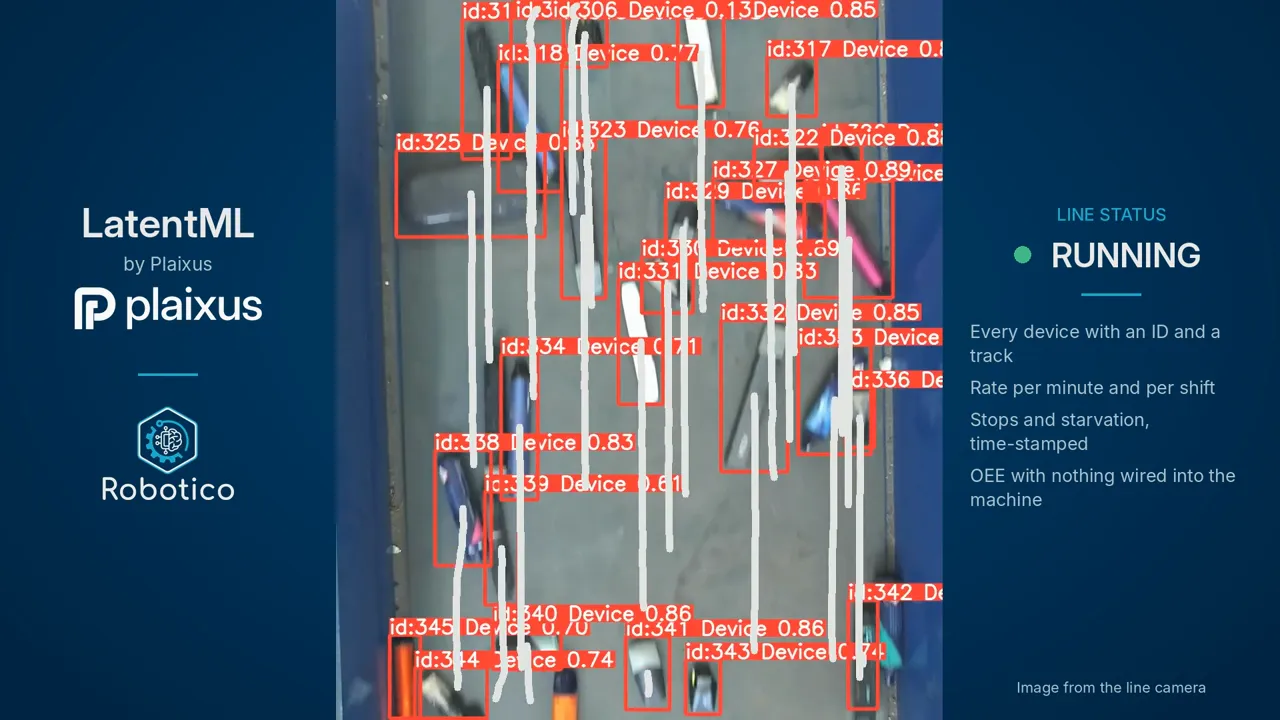
LatentML film frame: a camera view of a conveyor with every device boxed and numbered, and the line status shown as running
Every device counted, and the line status read from the camera. From the film below.
Half a dayto fit a camera or an encoder, with no stoppage
30 minutesof normal production to teach the counting zone
0wires into the PLC, the cabinet or the machine
On sitethe video is processed at the line and never leaves the factory

The loss you do not see

Measure the manufacturing capacity you already own.

Capacity you already pay for

The average factory runs at about 60% OEE. The top quarter reaches 75%, and 85% is the benchmark most plants aim for. The gap is output you already pay for in labour, energy and depreciation, and do not receive at the end of the line.

Manual logs flatter the number

Operators record the long stops, not the micro-stops under a minute or two. On many lines the short ones add up to more lost time than the long ones.

Wiring is the bottleneck

A typical plant has controllers from several makers and several decades, and older equipment gives no usable signal. Every machine needs its own sensor, its own cabling and a visit from an electrician.

OEE figures: TEEPTRAK Manufacturing OEE Benchmark Report 2026, normalised to ISO 22400-2.

What it does

One camera profile per type of process, not one wiring job per machine.

  • Counts cycles and good pieces at the point you choose: exit, entry or palletising.
  • Finds stops, slow cycles, product changeovers and waiting with the operator present, each with a timestamp and, with the camera, a short clip.
  • Asks the operator for the reason on a tablet or the line PC, only when a stop passes the limit you set.
  • Reports real-time OEE per machine, line and shift, a Pareto of losses, a shift handover summary and alerts by email.
  • Works the same way on a press from 1980 and a filler from 2024.

Option one

IP camera above the line

An IP66 camera counts cycles and finds stops and slow running. It also keeps a short clip of every event.

Option two

Clip-on encoder on the shaft

An IP67 encoder gives rate and stops with no line of sight. It is the route for enclosed cells and wash-down zones.

How it works

Four steps, and the line keeps running.

  1. InstallAn IP camera at the line or an encoder on a shaft. Half a day, with no stoppage.
  2. TeachYou mark the counting zone on screen. Thirty minutes of normal production.
  3. RunThe edge device counts and classifies line states on site, around the clock.
  4. ReportDashboards, a Pareto of losses, shift reports and stop reasons from the operator.
Line monitoring from a camera, in 67 seconds. A working line in electrical-waste recycling. No sound. The customer remains confidential.

Compared

Against OEE systems that wire a sensor to every machine.

LatentMLOEE systems with wired sensors
Installation per machineA camera on a bracket or a clip-on encoder. Ethernet or Wi-Fi.An IIoT device for every three inputs, a sensor or relay per machine, cabling to each, Ethernet per device.
A machine with no PLC or signalWorks.Needs a sensor added and wired.
Machines from different makersOne profile per type of process.One wiring study per type of machine.
Where the data is processedOn the edge device. The video never leaves.In the cloud.
What it measuresSlow cycles, changeover phases, operator presence, and a clip of every event.A pulse count and a running signal.
Total costPer line, per month, with the edge device.Per machine, per month, plus sensors and cabling.

Its limits

What it needs, stated before you ask.

The camera needs line of sight

Enclosed cells and wash-down zones call for the encoder instead.

Quality losses need a second input

A camera at the reject station, or an entry by the operator. Counting and availability come first.

Accuracy is checked on your line

We compare the count with your own, and write the result into the pilot's targets. We do not quote a general percentage.

Food and drink lines

Nothing is added to the machine

No wiring in the cabinet, and no change to a CE-marked machine or to the maker's warranty. Wash-down zones take the encoder, and the camera covers the dry zones.

Crates, trays and bottles

It counts crates, trays, bottles or cartons at the point you choose, and works beside Robotico's reading of labels and Data Matrix codes.

Data and the record

The video stays in the factory. The record is yours.

Personal data

Cameras point at the product flow, not at workstations. The video is processed on the edge device inside the factory and is not uploaded anywhere. Event clips are kept on site for as long as you decide. We document the processing for your GDPR records and provide the notice for your staff.

Part of the product's record

A Digital Product Passport is built from records. LatentML gives each line one: what it produced, and when it ran, stopped or waited. TraceLM holds the material side of the same record.

The passport, and how a factory gets ready

Questions

Common questions

Do you need to connect to the PLC?

No. LatentML reads the line from an IP camera or a clip-on encoder. There is no PLC integration, no relay or sensor in the cabinet, and nothing for the machine builder or the PLC supplier to do.

Does the video leave the factory?

No. The video is processed on the edge device at the line. Only counts and events leave it. Event clips are kept on site for as long as you decide.

How accurate is the count?

We check it against your own count during the feasibility check and write the result into the pilot's targets. We do not quote a general percentage, because it depends on the line.

How long does installation take?

Half a day for a camera or an encoder, with no stoppage. Teaching takes about thirty minutes of normal production: you mark the counting zone on screen.

What does it cost?

A nominal fee for the pilot. After the pilot, a subscription per line, per month, with the edge device included.

Who is behind it?

LatentML is Plaixus technology. Robotico surveys the site, fits the camera or encoder, commissions the edge device and the network, trains the operators and gives first-line support in Greek.
Next step

Start with one line.

Tell us the line, and the number you do not trust.

  1. An introductory call45 minutes, free. You describe the line and what you measure today.
  2. A feasibility checkTwo weeks. Where the equipment goes, lighting for the camera, and counting accuracy against your own count. It ends in a go or a no-go.
  3. A pilot on one line8 to 12 weeks at your site, with targets agreed in writing before we start.

What to tell us

  • The line and what it makes
  • How you count and log stops today
  • Shifts per day
  • Whether the line has wash-down zones

LatentML is Plaixus technology. Robotico installs and supports it in Greece: robotico.gr.

Start a LatentML pilot

An engineer, not a sales rep, replies within one business day.

We reply within one business day. Your details are used only to answer your enquiry. Privacy.